
la ligaabout 6 hours ago
Atletico Madrid vs Real Madrid — The Rivalry That Redefines Madrid
More than a game, the Madrid Derby is a battle for identity. From historic upsets to Champions League heartbreak, this is football's most underrated rivalry.

Hansi Flick has instilled a bold, structured style at Barcelona, blending aggressive pressing with intelligent build-up. This is the complete tactical blueprint behind the Blaugrana's resurgence.
Barcelona’s football has regained its bite — not through nostalgia, but through a ruthless, modern overhaul led by Hansi Flick. Gone is the passive possession of recent years; in its place stands a dynamic, high-energy system built on clarity, aggression, and positional intelligence. Flick hasn’t just changed formations — he’s changed the club’s DNA.
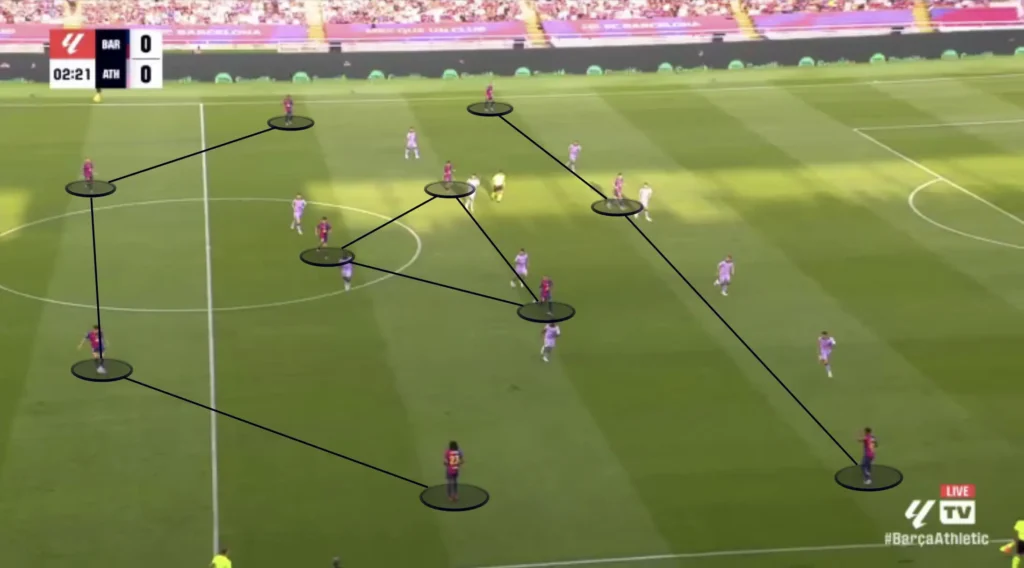
Hansi Flick has settled on a 4-2-3-1 as his base formation at Barcelona — a structure that offers both defensive solidity and attacking flexibility. The double pivot, typically formed by Frenkie de Jong and Gavi, provides balance, allowing the full-backs to push high while maintaining cover in transition. In advanced phases, this shape morphs into a 4-3-3, with one of the pivots advancing to form a midfield trio alongside Pedri, the team’s chief playmaker.
This adaptability prevents opponents from easily predicting passing lanes or marking assignments. Flick demands constant rotation between the attacking midfielders and wingers, creating overloads in central zones and dragging defenders out of position. The system is less about fixed roles and more about dynamic interplay — a hybrid of traditional Catalan possession and German efficiency. It’s not tiki-taka reborn; it’s tiki-taka weaponized.
Flick’s pressing is not reactive — it’s premeditated. The moment Barcelona lose the ball, a coordinated trap is activated. Robert Lewandowski, despite his role as the central striker, initiates the press by cutting passing lanes to the opposition’s deepest midfielder. The two #8s — Gavi and Pedri — then step forward to close down the half-spaces, while the full-backs tuck in to compress the centre.
This compact, high-block structure forces opponents wide or backward, where Barcelona’s midfielders are ready to pounce. The triggers are precise: a poor touch, a backward pass, or a central defender receiving under pressure. Once the ball is won back in the final third, the transition is immediate — with Raphinha and Ferran Torres making runs in behind. This isn’t just pressing; it’s a tactical ambush.
Barcelona still values possession, but under Flick, it has a clear purpose: progression, not circulation. The build-up often begins with ter Stegen stepping high to receive the ball, functioning as a sweeper-keeper-playmaker. The two centre-backs — Ronald Araújo and Andreas Christensen — spread wide to create a back three in possession, drawing opposition forwards and opening passing lanes.
From there, the ball is moved quickly through the double pivot, with de Jong often dropping deep to collect and switch play. The full-backs advance aggressively, with Balde hugging the touchline and Koundé cutting inside as an inverted option. The attacking midfielders rotate constantly, creating triangles and diamonds across the pitch. The end product? A layered, multi-dimensional attack that keeps defenders guessing.
Set pieces have become a hallmark of Flick’s Barcelona. Corners are delivered with variation — some inswinging, others short — while decoy runners create confusion in the box. Araújo and Christensen are aerial threats, but Flick also uses midfielders like de Jong and Gavi to attack the edge of the six-yard box for first-time finishes.
Free kicks are equally dangerous. Instead of predictable crosses, Flick encourages short routines and flick-ons to release runners into space. Direct efforts from Raphinha and Pedri add another layer of unpredictability. Analysts suggest Barcelona’s set-piece efficiency has risen dramatically since Flick’s arrival, making them one of Europe’s most lethal teams from dead-ball situations.
Several players embody Flick’s vision. Pedri is the metronome, dictating tempo and unlocking defences with incisive passes. Gavi is the engine, covering every blade of grass, pressing relentlessly, and linking play with aggression. Robert Lewandowski remains pivotal — not just as a finisher, but as a pressing trigger and target man.
The full-backs are redefined: Balde as a traditional overlap threat, Koundé as a hybrid defender-creator. And ter Stegen is arguably the most important — his ability to start attacks from deep sets the tone. Each player has a clearly defined role, and each executes it with tactical discipline. This is not individual brilliance — it’s collective intelligence.
"Flick has given Barcelona clarity in a way few managers could — a structured system that’s both aggressive and intelligent." — Tactical Analyst, The Athletic
No system is flawless. Flick’s high press can be exploited by teams that drop deep and defend compactly, forcing Barça into lateral circulation. Without consistent verticality, the attack can become predictable. Additionally, the reliance on Pedri and de Jong means injuries to either could destabilize the entire midfield structure.
The advanced full-backs also leave space in behind, particularly against pacey wingers. Teams like PSG or Arsenal could target these zones in transition. Finally, the intensity required is physically taxing — in tight matches, Barcelona have occasionally dropped off in the final 15 minutes. While Flick has restored pride, the ultimate test remains consistency in Europe’s biggest games.
Q: What formation does Hansi Flick play at Barcelona?
A: Hansi Flick primarily uses a 4-2-3-1 formation, which fluidly transitions into a 4-3-3 in possession. This setup allows for a balanced double pivot while enabling creative freedom for the attacking trio behind the striker.
Q: What is Hansi Flick's coaching philosophy?
A: Flick’s philosophy combines aggressive, coordinated pressing with intelligent build-up play and rapid transitions. He emphasizes positional discipline, high intensity, and structured rotations, creating a system that is both tactically rigid and dynamically fluid.
Q: Is Hansi Flick the best manager in the world?
A: While he has yet to win a major trophy with Barcelona, Flick is widely regarded as one of the top managers globally. His ability to instill a clear identity, improve team cohesion, and adapt tactically has earned him praise from peers and analysts alike.

