Barcelona no longer plays to pass the time — they play to break you. Under Hansi Flick, the Catalan giants have adopted a ruthless, high-octane style that blends German efficiency with Spanish flair. The days of slow build-up are gone; in their place is a system built on speed, pressure, and surgical precision.
- Base formation: 4-2-3-1, fluid in attack
- Pressing style: Coordinated high press with instant transitions
- Key player: Pedri as the creative hub between lines
- Set-piece strength: Complex routines with decoy runs and quick deliveries
- Exploitable weakness: Vulnerability to counters down the flanks
The Formation: What Hansi Flick Uses at Barcelona
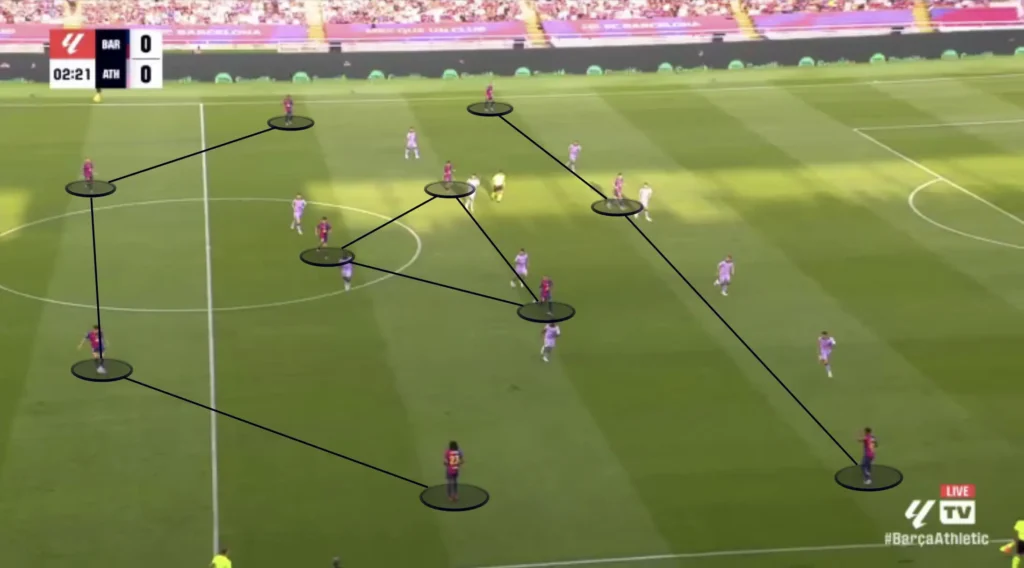
Hansi Flick is known to deploy a 4-2-3-1 as his base shape, but at Barcelona, it’s far from rigid. In possession, the system morphs dynamically: one of the double pivot drops deep, while the full-backs push high, effectively creating a 3-2-4-1 in the final third. This fluidity allows Barcelona to overload central areas and stretch defences laterally.
Jules Koundé and Alejandro Balde are critical to this structure. Unlike traditional full-backs, they operate as inverted wingers on the right and attacking overlappers on the left. Their movement drags defenders out of position, opening channels for Gavi to exploit between the lines. This adaptability makes Barcelona unpredictable and hard to contain.
Out of Possession: Pressing Philosophy
Flick’s pressing is not chaotic — it’s meticulously choreographed. The first line, led by Robert Lewandowski and Gavi, cuts passing lanes to the opposition’s deepest midfielder. Once the trigger is activated — often when the ball enters a specific zone — the entire unit surges forward in unison.
This coordinated press forces rushed clearances or misplaced passes, which Barcelona capitalizes on immediately. Analysts suggest the team has one of the highest PPDA (passes allowed per defensive action) in La Liga, indicating relentless pressure. The double pivot, typically Frenkie de Jong and a more defensive-minded partner, shields the backline while ready to launch counters.
In Possession: How Barcelona Build Play
Barcelona’s build-up is no longer about endless circulation. Flick demands quick progression: short passes to draw pressure, then rapid verticality. Pedri operates as a free-roaming '10', dropping deep or drifting wide to receive the ball in pockets of space.
The double pivot rotates intelligently — De Jong often drops between centre-backs to form a back three, inviting pressure before switching play. Meanwhile, Gavi pushes forward, linking midfield and attack. This constant movement disrupts compact defences. Lamine Yamal, cutting in from the right, combines with overlapping runs, creating overloads that lead to high-quality chances.
Set Pieces: An Underrated Weapon
Under Flick, set-pieces have become a potent offensive tool. Corners and free-kicks feature rehearsed routines with decoy runs and quick triggers. Ronald Araújo and Koundé are aerial threats, but the real danger lies in the movement.
One common variation sees Yamal fake taking the corner while De Jong delivers a short pass to a midfielder lurking just outside the box. This freezes defenders and creates shooting opportunities. Reports suggest Barcelona has scored more from set-pieces this season than in the previous two campaigns combined, highlighting their improved efficiency.
The Key Tactical Roles That Make It All Work
Pedri is the engine, but Gavi is the heartbeat — his work rate, defensive contribution, and ability to transition quickly define the team’s intensity. Lewandowski has evolved into a deeper playmaker, dropping to link play and create space for Ferran Torres or Yamal to exploit.
Ronald Araújo provides defensive stability and recovery speed, essential for covering the spaces left by high full-backs. Meanwhile, De Jong’s composure under pressure ensures Barcelona maintains control during transitions. Each player has a clearly defined role, yet retains enough freedom to improvise — the hallmark of Flick’s leadership.
Q: What is Hansi Flick's coaching philosophy?
A: His philosophy centers on aggressive pressing, rapid transitions, and vertical attacking. He emphasizes team cohesion, positional discipline, and exploiting space behind defensive lines — principles honed during his Bayern Munich tenure.
Q: Is Hansi Flick the best manager in the world?
A: While opinions vary, Flick is widely regarded as one of the top tacticians in football. His ability to rebuild Barcelona’s identity and implement a high-intensity system has earned him global acclaim in the 2025-26 season.